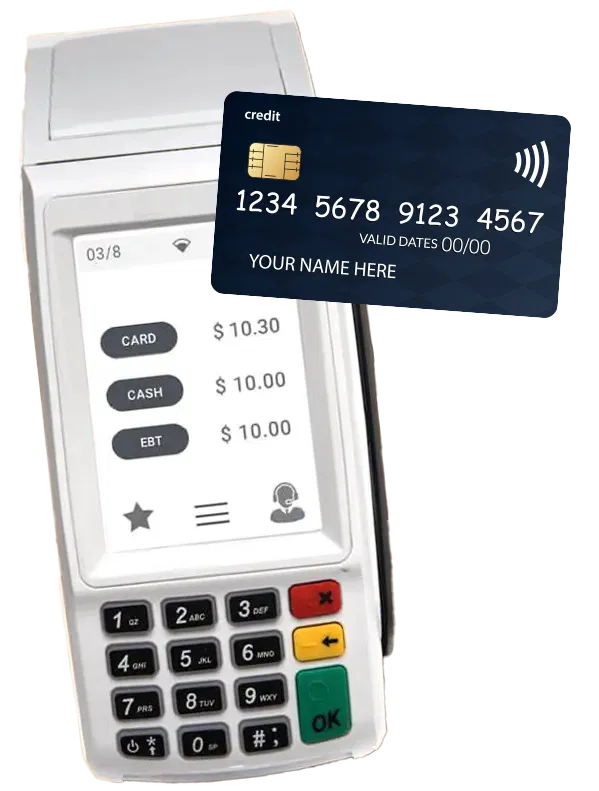
Credit card processing fees can quietly cut into the revenue from every sale. Dual pricing is one way for a business to address those costs while showing customers the price for paying with cash and the price for paying by card, before checkout.
But “zero-fee processing” should not mean confusing customers or adding an unexpected charge at the register. Here’s how dual pricing works, how it differs from surcharging and cash discounting, and what to check before adopting a program.
What is dual pricing?
Dual pricing displays two prices for the same product or service: a cash price and a card price. The customer sees both prices before deciding how to pay.
For example, a menu, price tag, service estimate, or point-of-sale display might show:
- Cash price: $X
- Card price: $Y
The actual amounts depend on the business and its pricing. The important part is that the prices are clearly presented in advance. A card price should not be added as a surprise fee after a customer chooses a payment method.
In a properly configured program, the business uses its listed card price for card purchases and the displayed cash price when a customer pays with cash. This is different from adding a new “processing fee” to the bill at checkout.
Dual pricing doesn’t make the underlying economics of accepting cards disappear. Instead, it changes how the business presents prices and accounts for payment costs. Ask the provider to explain exactly how your prices, transactions, receipts, and statements will work.
How does dual pricing work?
A dual pricing program generally involves a few connected pieces:
- Prices are set and displayed. The business determines its cash and card prices with its provider and displays them before purchase.
- Customers choose how to pay. They can see the relevant prices before making that choice.
- The point-of-sale system applies the correct price. It should be configured to match the prices shown to customers.
- The receipt reflects the transaction clearly. Customers should be able to understand what they bought and what they paid.
The details matter. A sign alone may not resolve a mismatch between advertised prices, the point-of-sale total, and the receipt. Before launch, review the full customer journey, from a menu or estimate to the final receipt.

Dual pricing vs. surcharging vs. cash discounting
These terms are sometimes used interchangeably in sales conversations, but the pricing structure and applicable rules can differ.
| Approach | What the customer sees | What to check |
|---|---|---|
| Dual pricing | Cash and card prices are displayed before purchase. | Both prices should be clear and consistent across displays, checkout, and receipts. |
| Surcharging | An additional charge is added for using a credit card. | Card-network and state requirements apply. Visa says debit and prepaid cards cannot be surcharged under its U.S. rules. |
| Cash discounting | A discount is offered for paying with cash, based on a clearly communicated regular price. | The discount must be presented as a real reduction from the regular price, not a hidden card fee. |
The federal statute on payment-card network rules defines a discount as a reduction from the price customers are informed is the regular price, not an increase to that price. It also requires discounts to be disclosed clearly and conspicuously where applicable. Read 15 U.S.C. § 1693o-2.
The distinction between these models is not just a matter of wording. If a business posts one price and adds a card fee later, that may be treated as a surcharge, whatever the fee is called. Visa’s merchant surcharge Q&A explains its requirements for surcharging, including that Visa debit and prepaid cards cannot be surcharged.
Is dual pricing legal?
Dual pricing, surcharging, and cash discounting are not governed by one simple rule that applies identically to every business and transaction. Requirements can depend on location, payment method, card-network rules, and how prices are presented. Rules can also change.
For example, Connecticut’s Department of Consumer Protection says businesses may not charge customers a surcharge for using one payment type over another, but may offer a cash discount or list cash and credit-card prices separately. See the state’s surcharge guidance.
That example is a reminder to check the rules where your business operates rather than relying on a generic “legal in all states” claim. Debit cards also require particular care: do not assume a program may add a debit-card surcharge just because a customer selects “credit” on a terminal. Visa states that this choice does not change a debit card into a credit card for surcharge purposes.
Before you implement any pricing model, confirm the setup with your payment provider and, if needed, a qualified legal professional. This article is general information, not legal advice.
Who is dual pricing for, and who should think twice?
Dual pricing may be worth exploring if you run a business where customers can see prices before paying. That covers most of the small businesses on a US main street: restaurants and bars, auto repair shops, nail and hair salons, locksmiths, law offices, retail stores, medical offices, churches, and trades that hand over an estimate before the work starts. Taxis and rideshare drivers fall into the same group, since the fare is quoted up front.
It may be less suitable if:
- Your prices are difficult to display consistently before purchase.
- Your customers expect a single all-in price and may react poorly to two displayed prices.
- Your business relies on online, phone, or recurring payments and has not confirmed how both prices will be disclosed there.
- Your existing software or workflow cannot reliably apply and show the correct price.
- You are unwilling to train staff to explain the options clearly.
A program should fit your customer experience and operations, not just promise to reduce a line item on a statement.

How to set up a dual pricing program
- Review your current processing costs. Gather recent merchant statements and identify the charges you pay today. A statement review can help you compare your current setup with a proposed one.
- Confirm the pricing model. Ask whether the program is dual pricing, cash discounting, surcharging, or a combination, and how it handles debit, prepaid, and other payment types.
- Plan where prices will appear. Consider menus, shelf labels, service estimates, website pages, checkout screens, and any other place a customer sees a price.
- Check your equipment and software. Confirm the point-of-sale system can display the prices and produce understandable receipts. Ask what equipment, software, and setup support are included.
- Train your team. Give employees a short, straightforward explanation of the two prices and how to answer questions without implying a fee will be added unexpectedly.
- Test before launch. Run sample transactions using different payment methods. Check that the displayed price, terminal total, and receipt make sense together.
- Review after launch. Monitor customer questions and review your statements to confirm the program is working as explained.
Common customer questions, and clear answers
“Why are there two prices?” “Both prices are shown before you pay. You can choose the displayed cash price or the displayed card price.”
“Is this an extra fee?” “The prices are displayed in advance. We don’t add an unexpected fee at the register.”
“Can I use a debit card?” “Yes. The card price applies to card payments.” Debit cards are the reason the distinction matters: a surcharge cannot be applied to them under the card networks’ U.S. rules, while dual pricing shows one card price for all of them.
Clear answers work best when they match the signage, system, and receipt.
Explore a transparent processing option
Zero Fee Payment Solutions helps businesses evaluate ways to reduce or eliminate their processing fees. Its Dual Pricing Program displays cash and card prices, while Interchange Plus Pricing is available for businesses that prefer traditional processing. The company also offers free payment processing equipment and software, no long-term contracts, and a free merchant statement analysis, usually delivered within 24 hours.
To see what your current statement shows, request a free merchant statement analysis. A clear review can help you compare options before deciding what fits your business.